

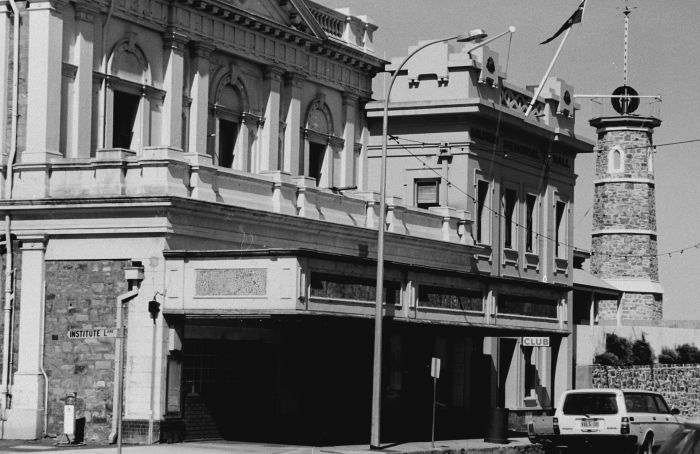
History of Semaphore Library
The Semaphore Library was officially opened as the Semaphore Institute on 15 March 1884 by Governor Sir William Robinson. On opening the Governor said “the opening of such a fine building marks the progress of Semaphore from a special way, the progress of a town.”
The Semaphore Institute
The Semaphore Institute was designed by Wright and James, Henry Reed in a Victorian Classical style. William James William Reed had previously designed over 70 buildings, some with an iron roof, including the theatrical performance and performing arts facilities in the complex.
The building had a reading room, library and retiring and cloak rooms. The first floor housed the concert room for offices and a gallery. The interior of the Institute was “plainly but richly furnished, with a reading room and hall all having cornices.” The hall was lighted by twelve gas pendants; the rooms downstairs by an entirely new invention, by which either the inner or outer circle of lights could be turned on or off independently.
Of the Institute building, the Governor stated:
“I have been told since entering here, that ten years ago Semaphore consisted of sand hills on the seacoast, with one or two families living here, and now you have a fine rising town with a population of 5,000 people.
“I venture to say the money is well spent because Institutes are educational in character… where people can meet for the purposes of recreation, instruction and general entertainment.”
During the years that followed, many groups utilised the Semaphore Institute, including the Semaphore Bowling Club, Mrs Carry Nelson’s Operetta Company and the Port Adelaide and Semaphore Cycling Club. The hall was also used for dances, scout meetings, dressmaking classes and temporary accommodation.
Theatres
Pictures began screening People’s Picture Company movies in 1910 and Semaphore Wonderland Pictures screened matinees from 1913.
In 1911 Hugh Waterman, a bookseller and stationer on Semaphore Road, formed a company to build the first purpose-built indoor picture theatre in Port Adelaide in 1913. Each screening in the Semaphore Institute twice a week from December 1918.
In 1929 Ozone Amusements leased the building from the City of Port Adelaide and made a number of alterations that converted the Institute into a Cinema. Architect Chris A. Smith designed the conversion and all work was carried out at a cost of 16,000 pounds, with 424 dress circle seats, 456 side box seats, 616 stalls and 55 sets of seat chairs.
Hoyts Theatres Ltd acquired the Semaphore Ozone along with most of the other Amusements in 1951. In 1952 they refurbished the Semaphore Ozone with new carpets, chandeliers, theatre lighting and new seating arrangements. The building had a seating capacity of 950 and was considered at the time to be the best equipped theatre of its kind in South Australia. On 20 November 1952, a Newsreel Cinema opened in the former gallery portion of the evening theatre and featured Robert Taylor and Elizabeth Taylor in Ivanhoe.
The introduction of television in May 1959 saw a decline in cinema attendances. The Semaphore Ozone closed on 21 May 1960, with the last films screened Tarzan’s Greatest Adventure and I Mobster. When the Ozone closed the ground floor seats were removed, while the seats in the foyer and dress circle remained. The name of the revived Semaphore Cinema survived in the projection area of the revived Semaphore Cinema.
Conversion to Library
The Semaphore Youth Club occupied the downstairs section of the building from 1960 to 1983 and the City of Port Adelaide considered converting the lower part of the building into a library with the theatre remaining upstairs. However, due to the effects of noise, this option was discarded.
In 1993 work commenced to convert the building into the Semaphore Library. Architects Berriman & Associates, builders Coombs and Barei, and interior designers Whitehead & Associates were involved in the conversion.
The safety interior cathedral art deco ceiling and chandeliers, some ornamental fireplaces and grand staircase were maintained.
The library was officially opened on 11 February 1994 by the Honourable John Oswald MP, Minister for Housing, Urban Development and Local Government Relations.